People make New Years resolutions. Mine was to read a page of Talmud every day, a practice known as daf yomi. There are 2,711 pages of Talmud. It will take over 7.5 years. This is my daily blog with at least one gem from each page I have read. Join me, and see this sacred book through the eyes of a progressive female Rabbi.
When you have to explain a joke – that’s not a good sign. That’s how I feel reading today’s daf. The rabbis love to give acronyms to help us remember the order of things, and today we get a wonderful acronym to help us remmeber the order of blessing things when Shabbat ends as the festival of PAssover begins (and we have to make Havdalah AND begin the Seder and festival blessings).
Opinion 1: Abaye said that the proper order is yod, kuf, zayin, nun, heh.
Opinion 2: Rava said the order is yod, kuf, nun, heh, zayin.
And, the winner goes to: The halakhah is in accordance with the opinion of Rava.
Each of these letters symbolize a piece of the blessings – as they are the fisrt letter int he hebrew of that action (yod – wine; kuf – kiddish; nun – candle; hey – havdalah; and zayin – the time/festival). But, how do we remember the order? You can simply say the acronym “YaKNeHaZ” to remind yourself of the correct order of blessings.
Think that’s a hard word to remember? Well, the rabbis didn’t because it sounded like another phrase: jag den has. Apparently, this meant hunt for rabbit. Mind you, rabbit is not kosher – and so, if you dont’ know what this stands for, then seeing depictions on old haggadot of a rabbit hunt is very strange indeed.
Inside joke – totally needs to be explained. But, also helpful for us to remember this mnemonic tool.
Rav Huna said that Rav Sheshet said: One does not recite two sanctifications, i.e., for two mitzvot such as Grace after Meals and kiddush, over one cup. What is the reason for this halakha? Rav Naḥman bar Yitzḥak said: Because one does not perform mitzvot in bundles.
If you have a sibling, you know the feeling of having to share attention. This is good, and healthy – we should not be the sun around which our parents orbit. However, you also know that sometimes just want the attention to be on you. Every person needs their moment to shine, their moment to feel as if they’re the sun. Our gem teaches us, that this is true of mitzvot as well.
“One does not perform mitzvot in bundles” does not mean that we don’t do as many mitzvot as we can, it means that we give each mitzvah is’t own moment. When doing a mitzvah we give it our attention, our Kavanah. The gloss says, “If someone performs multiple mitzvot all in one go, he gives the impression that they are a burdensome obligation that he wants to complete as fast as possible.”
It’s not uncommon (pre-covid) that I would make kiddush at temple, lead services, then come home to have my Shabbat meal. So, today’s daf asks a question that I have had as well: if you make kiddish at shul, do you need to make it again when you come home?
According to Rav: if you made kiddish at shul, you need to do it again when you get home for the sake of your family members (so they can hear it); but this implies that if you live alone, the blessing said at shul woudl have you “covered” for the rest of the evening.
Shmuel disagrees. In his opinion, the blessing said in shul is only for visitors who are sleeping in the synagogue, but even if you live alone, you say the kiddish again when you get back to your house.
Then we get a great rule – kiddish must be said in the place where you eat.
I love this little gem. First, I have leanred to go ahead and say the kiddish again when I get home (which I did anyways because of the same thinking as Rav – I wanted my kids to hear). And second, there is something so Shabbisdic about blessing and then sitting down to enjoy the food and company. The holiness of Shabbat is not just the prayers, but also in what is found around that table – special food, special people, special wine, and singing blessings only elevates it further.
When you ask a rabbi why we cover our eyes and say the blessing after we light the Shabbat candles, you will likely get a lovely drash, but the real reason is a bit of magic. The order of blessing (in general, lots of exceptions) is 1) say the blessing, 2) do the action. We bless the wine, then drink, bless the challah then eat – but you can’t do that with Shabbat candles as if you say the blessing, then Shabbat has begun, and you can no longer light the candles. So, we do a bit of magic. We light the candles and cover our eyes, pretending they are not lit, then we say the blessing and open our eyes and – voila – magically the Shabbat candles are lit.
Why am I talking about this?
Well, there is a bit of that same Shabbat magic on today’s daf. The question is, if we are sitting down to our seder meal, and eating, when the time comes to make Shabbat kiddish – what do you do? Do you move the table out of the room (apparently people had TV tray type tables they ate off of for a time)? How do you make it Shabbat time?
The Gemara relates: Rabba bar Rav Huna happened to come to the house of the Exilarch. His hosts were reclining for a meal (that Passover reclining), and the attendants brought a table before him so he could eat as well. Since Shabbat had already started, he spread a cloth over the food and recited kiddush. That was also taught in a baraita: And the Sages agree . . . if one brought out the table before kiddush, he should spread a cloth over the food and recite kiddush.
We take a cover, spread it over the food, and then recite the Shabbat blessings. Then, when we remove the cover – voila – and make the motzie over challah – it is “as if” we are magically at a new meal, our Shabbat meal.
My gem? Well, I am a rabbi who teaches that we cover the challah on Shabbat so as to not hurt it’s feelings (since it is the last thing to be blessed). If we worry about the feelings of bread, all the more so we should worry about the feelings of other people. But, here, on today’s daf, might be the real reason – so we can pull off the cover and -voila – whatever was on our table is not special for the Shabbat meal.
A gem in the first line! And a great way to end the chapter on “one who was impure and had to observe the second Passover.”
Background according to the Mishna: In the case of two individuals whose Paschal lambs became intermingled and each person was the only one registered for his offering, what should they do? They have a lottery! Pick their animal from drawing lots, registere a second person for their animal and this is what they say: If this Paschal lamb is mine, you are withdrawn from yours and you are registered for mine, and if this is your Paschal lamb, I am withdrawn from mine and I am hereby registered for yours. . . from this we get our gem on the top of today’s daf:
From here the Sages stated: Silence is fitting for the wise, and a fortiori the same is true for fools. (Meaning, if silence is fitting for wise people – all the more so it is fitting for fools!) This is as it is stated: “Even a fool, when he holds his peace, is considered wise; and he that shuts his lips is esteemed as a man of understanding” (Proverbs 17:28).
What’s happening? In the case under discussion, had neither side appointed the other to slaughter the Paschal lamb on its behalf, both offerings would be valid and would be consumed. However, if they do it as it’s described above – with each desgnating the other to slaughter on their behalf – then, as we read on the of yesterday’s daf: If he, the agent, said to the other members of the group that if they slaughter their Paschal lamb first they should include him, and they said to him that if he slaughters his Paschal lamb first he should include them, all of them eat from the first Paschal lamb that was slaughtered, and the second one must be burned. What a waste!
And what a lesson: Silence is fitting for the wise, and all the more so for fools.
Reminds me of Silent Bob from such movies as Clerks, Mallrats, Chasing Amy and Dogma. He was a character who never really spoke, hence the name Silent Bob. But, on the rare occasions he did, it was as if he was the Buddha – full of wisdom and clarity that none of the other characters seemed to have.
Rabbi Bookman once told me that before I speak (when giving advice) I should ask myself: Do I need to say this? and Do they need to hear this?
There is a scene on today’s daf, where a father is on his deathbed and yet they register him for a pascal lamb. The question is about if the son inherits this lamb if his father dies if he hasn’t been registered to it prior.
While the conversation has little to do with our world today, it does lead one to think about what we want our children to inherit and what we should give them rights to in our lifetimes so that there is no question after our deaths. I also read about situation where the lamb that the father was registered for, yet the son was not registered, has to go to pasture until it dies, or if it was slaughtered has to be burnt and not consumed – and I think of all the waste that happens when someone passes – all the things that just get tossed.
Reading today’s daf I had “I once, was lost, but now I’m found; was blind, but now I see!” running through my mind. But maybe “Little Bo Peep has lost her sheep” woudl have been more fitting.
Today’s daf questions what we do when the pascal offering wanders away and becomes lost, so we take another lamb or goat and designate that for sacrifice, only to find the first lamb who was left “alone and they’ll come home, Bringing their tails behind them.” Now you have two sheep designated for the same purpose! What do you do?
The answer depends on when the sheep came back, if the sacrifice already happened or not, and – as always – which rabbi is talking.
Perhaps since my name, Rachel, means little lamb, I draw from this a lesson for humans who wander. . . you can always come back, but you may have lost your place in your wanderings. So, sometimes we need to commit.
In our world today, we are often so scared of closing any doors, of losing any part of our freedom, and so we don’t commit. As Rabbi Sacks says in his book Morality, “We seem to be making choices all the time, but too often they are choices not to choose, not to foreclose future options.”
What happens to that lamb who comes back? Either it fulfills a new purpose (as a peace offering), or it’s “put out to pasture” (pun totally intended).
According to the Rabbis, this animal goes for grazing, as we learned in a mishna: If one separated his sin-offering and it was lost, and he separated another in its place and the first was found, and therefore both are available, then one of them, whichever he chooses, is sacrificed, as he may bring only one offering, and the second shall be caused to die; this is the statement of Rabbi Yehuda HaNasi.
So, I started with two songs – I will end with one more. What can we learn from this daf? while wandering is an important piece of life and learning who we are, eventually we need to commit if we want to live lives of meaning. . . As Hamilton says, “I’m not giving away my shot.”
The Mishnah discusses the differences between the Passover which the Jews celebrated when they left Egypt and how the festival of Passover is celebrated by all subsequent generations. The Mishnah says that one difference is that the first Passover was observed for one night, while later Passovers are celebrated for seven days and nights (mind you it says Pascal Lamb but it means the entire holiday of Passover – somewhat confusing). The Gemara explains that on both the first Passover and every subsequent Passover the obligation to eat the pascal lamb applies only for one night. The difference is that, for the first Passover, the prohibition of Chametz applied during the first night and day, while the prohibition of Chametz of every other PAssover applies all seven days.
This is my gem because it helps to open up a question I have always had reading the Exodus. If Chametz was forbidden on the night and the day of Passover, even on the first Passover – which the Torah explicitly states, then why does the Torah say that the Jewish people took Matzah with them because “they were rushed out of Egypt and did not have time to make the dough into bread” (Shemos 12:39)? Why do we have this rule that they can’t have chameitz and then a verse that seems to say that we only ate matzah because the dough did not have time to rise? It seems that the Torah is implying that they would have made their dough into bread had they not been rushed out – what’s going on?
So, a little commentary from some smart medieval rabbis today (thanks to Rabbi Mordecai Kornfeld for these translations):
“The RAMBAN explains that the point of the verse in the Torah is to teach that had they not been rushed, they would have baked Matzah at home in Egypt, and not while in transit. The Torah relates that they baked the dough while they traveled because they were rushed out (and that is why it was still dough and not a finished product of Matzah). The emphasis is that they baked it on the road and not in Egypt. Had they not been rushed, they still would have baked Matzah, because Chametz was forbidden. However, they would have baked the Matzah in their homes and not while they traveled.”
“In a similar vein, the DA’AS ZEKENIM explains that when the Torah says that the Jewish people were rushed out of Mitzrayim, its intention is not to explain why the dough became Matzah and not Chametz. Chametz was forbidden, as the Gemara here says. Rather, the verse reveals why the only food that they brought with them was dough and nothing else. It was because they were rushed out and did not have time to prepare other provisions for themselves.”
So, while this may not have a today application, it has answered a question I have had for years about the Exodus, and for that, I am grateful.
We have been discussing the second Passover for a while now, this second chance at observing this important holiday, one that, if you purposefully abstain from observing, you are excommunicated. But is the second Passover exactly like the first (just a month later)?
MISHNA: What is the difference between the Paschal lamb offered on the first Pesaḥ and the Paschal lamb offered on the second Pesaḥ?
We learn that there are two major differences: 1) you don’t have to rid your house of leaven nor eat only matzah for an entire week and 2) the Paschal lamb offered on the firstPesaḥrequires the recitation of hallel as it is eaten and the second does not require the recitation of hallel as it is eaten. However, we do recite hallel while slaughtering.
Hallel are psalms of praise – they are sung! My gem comes from the answer to the Gemara’s question: What is the reason that hallel must be recited while one prepares the Paschal lamb on the second Pesaḥ? The Gemara answers: If you wish, say that the verse quoted above: “As in the night when a festival is sanctified,” excludes laws that apply at night, but it does not exclude laws that apply by day; therefore, the recitation of hallel is required while slaughtering the Paschal lamb on the second Pesaḥ just as it is required while slaughtering the Paschal lamb on the first Pesaḥ. And if you wish, say that this halakha simply makes logical sense: Is it possible that the Jewish people are slaughtering their Paschal lambs or taking their lulavim on Sukkotand not reciting hallel? It is inconceivable that they would not be reciting hallel and there is no need for an explicit biblical source for this halakha.
I love this. Yes, we can interpret a verse for why we would sing hallel while slaughtering, however, who needs a verse? This is just what we do! I love not being able to imagine Jews performing religious rituals without song – because I can’t either.
Music lifts the spirit. It expresses desires of the soul that words alone can’t quite capture. Singing elevates us and the rituals we perform.
I once asked a congregant, a regular, why she comes to services every week, what does she get from them? She told me, “It’s the only time I sing out loud wit other people during my week.”
To quote Madonna, “Music makes the people come together.”
Today’s sound track goes to Indigo Girls: Galileo (I just had to bust out my guitar and play the song, I am a female who grew up in the 80s and 90s . . .).
Today’s daf title? Bad science.
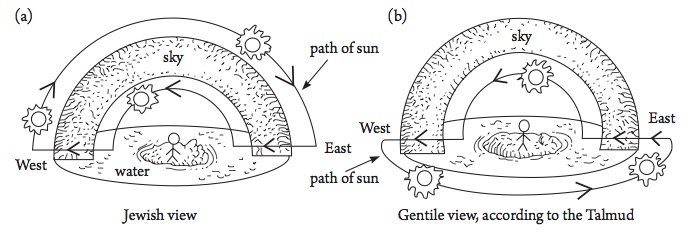
In trying to determine what counts as “being away on a journey” and therefore being exempt from bringing the Passover sacrifice, the rabbis try and calculate distances . . . and they’re way off base. First, they are assuming the earth is flat, which leads them to believe strange things about the sun and where it goes when it’s dark. Talmudology included a great illustration of this from Judah Landa. Torah and Science. Ktav 1991. p63
We get such offbase statements as: Rava said: The size of the world is six thousand parasangs (a parsange is 3.5 miles so 21,000 miles, the earth is actually 196,939,900 sq miles), and the thickness of the firmament is one thousand parasang (the exosphere alone is 10,000 mi).
Rabbi Yehuda says: The thickness of the firmament is only one-tenth of the distance that the sun travels during the day. Also wrong.
The size of Egypt was four hundred parasangs by four hundred parasangs, and Egypt is one-sixtieth of the size of Cush, and Cush is one-sixtieth of the world, and the world is one-sixtieth the size of the Garden of Eden, and the Garden of Eden is one-sixtieth of Eden, and Eden is one sixtieth of the size of Gehenna. Therefore, it is found that the entire world is like a pot cover, which is a small part of the total size of the pot, compared to Gehenna. All of these ratios are wrong; except maybe the size of hell (Gehenna) as no scientist has given us the proper measurment.
If I listed all the bad science, I would be copying the whole page. But let me bring you back to the sun question to give you my gem:
The Jewish Sages say that during the day the sun travels beneath the firmament and is therefore visible, and at night it travels above the firmament. And the sages of the nations of the world say that during the day the sun travels beneath the firmament, and at night it travels beneath the earth and around to the other side of the world. Rabbi Yehuda HaNasi said: And the statement of the sages of the nations of the world appears to be more accurate than our statement. A proof to this is that during the day, springs that originate deep in the ground are cold, and during the night they are hot compared to the air temperature, which supports the theory that these springs are warmed by the sun as it travels beneath the earth.
His reason for believing the sages of the world is inaccurate – but that he is willing to say – they seem to be more correct than we are is a gem indeed.
Science, while seeming on its surface to give cold and hard facts, is an evolving science. At any time, we are simply using the best theories we have available. These theories change over time as we learn more about the world (and outerspace) and come up with theories that better capture the reality of what we experience.
I love this. For me, science is very akin to theology.
It may seem that we believers in God are also firm in hard and cold facts – but we are not either. Faith is different from fact. Faith is belief with knowing that we cannot know completely.
The Talmud opens the rabbis up to finding truth outside of their world and their brilliant minds. Science does so as well.
Faith and science, while being put at odds so often, both rely on working theories and the possibility of a higher truth – a truth we are always working to get closer to.

 2,711 pages of Talmud. A gem a day.