Sukkah 5

Today’s theme, mentioned 3 times on the daf: If you grasped many, you did not grasp anything; if you grasped few, you grasped something.

This expression comes up multiple times on the daf today. The daf is trying to determin the height of the ark-cover (it gives the length and width). Therefore, the rabbis need to derive it somehow midrashically by comparing it to things that the Torah DOES give the size of, which leads to some hilarious ideas (as we shall see below). But three times this funny idiom is used to teach that, when in doubt in a measurement, be a minimalist.

Some of the comparisons the daf uses to find the height include:

  1. the frontplate (this is rejected as an ornament and not a true vessel)
  2. the crown featured atop several of the Tabernacle vessels (this si rejected as it’s part of the “finish” and not a vessel)
  3. border of the table (again, this is rejected as it’s part of the finish)
  4. Then Rav Huna said that the thickness of the Ark cover is derived from here: “Upon the face of [penei] the Ark cover on the east” (Leviticus 16:14), and there is no face [panim] of a person that measures less than one handbreadth. So, now we need face sizes to find the height.
  5. Suggestion 1: Say that the Ark cover is like the face of a bird called bar Yokhani. Bar-Yokani is a legendarily large bird. The yoke of the egg was enough to drown sixty cities (Bechorot 57b). Its face must have been huge! So if we are deriving the size of the ark-cover from the size of a face, maybe the face would have be as large as this bird’s face. However, the Talmud rejects this with the same principle we saw earlier—whenever possible we should be minimalist in deriving measures. We should derive the “face” of the ark-cover from the smallest face, and not from the largest one.
  6. Suggestion 2: say that it is like the face of a bird, which is extremely small? (If you’re going to use a bird, one not a tiny bird? This is also rejected.
  7. Suggestion 3: And let us derive a verbal analogy from the face of God. Wow! How big is that? Again, our favorite idiom comes in to save the day: If you grasped many, you did not grasp anything; if you grasped few, you grasped something.
  8. Suggestion 4: cherubs

You get the idea – in the end, the winning suggestion is a human face. Great to learn about large and small birds on the daf, but the real gem is the expression: If you grasped many, you did not grasp anything; if you grasped few, you grasped something.

While here, it reminds us to go for smaller measures (think, “don’t bite off more than you can chew”), it also teaches us that sometimes we try to learn to much and therefore, don’t really take the time to learn anything at all, or do to much and so don’t do a good job with anything – while if we take on less we can really focus and learn something and accomplish something.
Sukkah 4

We continue to discuss the maximum height and minimum, for a Sukkah, a temporary home. Both words “temporary” and “home” come into play. It cannot be a permanent structure, yet, it also needs to be worthy of the title “home” if only for a week. As we read:

In a case where the sukka was only ten handbreadths high, the minimum height for a fit sukka, but the ends of the palm leaves fall within ten handbreadths, Abaye thought to say: If the sunlight in the sukka is greater than the shade, the sukka is fit.

Rava said to him: No, that is considered a sagging [seruḥa] residence, and a person does not reside in a sagging residence.

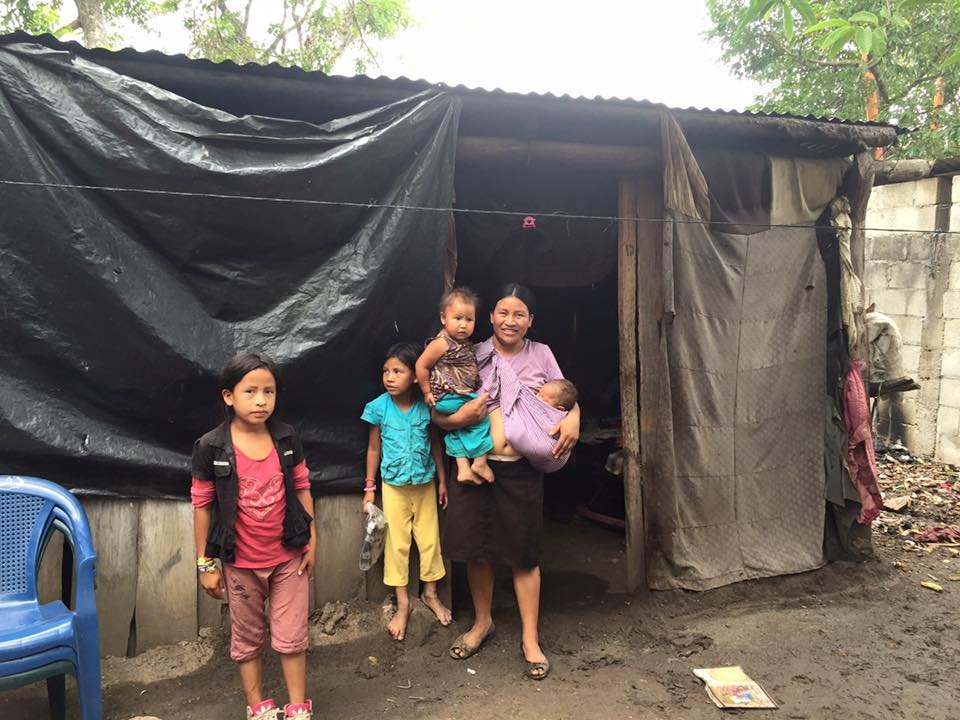
It’s been so long since I traveled, but one thing I remember seeing in many places of poverty, are little sukkot that people built to house themselves and their families.

In Guatemala, Peru, and India (I know there are many more, but these are places I have traveled) I saw sukkot homes. They look (from an affluent American perspective) like little huts, like they are not residences, but in reality, if you go inside, they’re beautiful homes. I am pasting pictures from Guatemala (from the internet) and from Mumbai below. The picture from Mumbai was in the Dharavi slum (famous from Slumdog Millionaire). Here, we took a tour dugin a monsoon and were invited inside a hope to find shelter from the rain. It was so small, but inside, lovely.

It reminds us or what is important in a home – what’s inside. And it reminds us that we are all deserving of the dignity of having a place to call home.

Diapers for Children in Poverty in Guatemala - GlobalGiving
May be an image of 3 people, including John Crary and people smiling

Sukkah 3

Yesterday we learned about the maximum height of a Sukkah, today we learn about the minimum size: 4 cubitz.

Tjos measurement may sound roughly familiar to you. That’s because it keeps coming up in the Talmud. 4 cubitz defines a private area and defines our personal space. For example, when someone is praying, are not supposed to walk within 4 cubitz of them. We learned in Shabbat that we are not supposed to carry an object more than 4 cubits into the public square and today we learn Rabbi Yehuda HaNasi says: Any sukka that does not have an area of at least four cubits by four cubits is unfit.

What’s interesting for us today is that, had we studied this the last round of daf yomi, 7.5 years ago, this would have felt distant and esoteric, it wouldn’t have stuck; but now it is all too familiar. 4 cubits is equivalent to 6 feet. We now completely understand that 6 feet is our personal space. 6 feet has defined where we can pray in shul, stand in line, and has become a defining number for our public areas as well.

While 6 feet has felt painful over the pandemic – keeping us from hugs, high fives, and feeling part of a crowd – we learn that 6 feet can define a holy space. Within this magic area, we can feel God’s protection, grow personally and spiritually, comune with the Divine.

May we all find holy spaces.

Sukkah 2

Welcome to tractate Sukkah! We will be discussing the laws around this temporary structure for the next 55 days (who knew there was so much to discuss!).

Today we begin with the roof – specifically the height of the roof. While it may be luxurious to walk into a home and see high vaulted ceilings, the sukkah is not supposed to be so fancy, so high, so exalted . . . but, as in everything in life, there’s always someone who has the best, fanciest, and – highest ceiling, as we learn today:

MISHNA: A sukka, i.e., its roofing, which is the main and most crucial element of the mitzva, that is more than twenty cubits high is unfit. Rabbi Yehuda deems it fit.

The Gemara explains:

From where are these matters, i.e., the halakha that a sukka may not exceed a height of twenty cubits, derived?

Rabba said that it is derived as the verse states: “So that your future generations will know that I caused the children of Israel to reside in sukkot when I took them out of the land of Egypt” (Leviticus 23:43). In a sukka up to twenty cubits high, even without a concerted effort, a person is aware that he is residing in a sukka. His eye catches sight of the roofing, evoking the sukka and its associated mitzvot. However, in a sukka that is more than twenty cubits high, a person is not aware that he is residing in a sukka because his eye does not involuntarily catch sight of the roof, as at that height, without a concerted effort one would not notice the roofing.

This argument continues – but the best proof is a lived experience, so, meet Queen Helene:

Rabbi Yehuda said: There was an incident involving Queen Helene in Lod where her sukka was more than twenty cubits high, and the Elders were entering and exiting the sukka and did not say anything to her about the sukka not being fit.

Proof! It can have a high ceiling. Or is it proof?
The Rabbis said to him: Is there proof from there? She was, after all, a woman and therefore exempt from the mitzva of sukka.
Rabbi Yehuda said to them in response: Didn’t she have seven sons and therefore require a fit sukka? And furthermore, she performed all of her actions only in accordance with the directives of the Sages.

On tomorrow’s daf, we learn that the Queen of Lod had an inter-chamber with a lower roof where she would sit out of modesty – so the debate continues. But this does make one ask – if a Sukkah has a larger goal of reminding us of a time when we were all sustained by God’s grace, when we were all equal in the desert, and no one had a fancy home . . . if a sukkah is supposed to give us humility, if it’s supposed to take us out of the materialism of our homes and sit us in a more spiritual space – then shouldn’t there be limitations on the grandness of the Sukkah? When does opulence make us lose sight of the greater goals of the holiday?

Yoma 88

Mazal tov! We have made it to the end of Yoma. Today’s tractate ends with . . . a nocturnal emission.

The daf discusses whether or not one needs to pray the evening prayer AFTER neila on Yom Kippur or if Neila counts. Then, the question becomes, if we’re not allowed to bathe, but he may not stand in a filthy place out of respect for the name, then what happens if he has a nocturnal emission? And they reason that, if one needs to immerse before neila – then neila counts as the evening prayer . . . the resolution: The Sages taught: One who sees an emission of semen on Yom Kippur descends and immerses.

A tanna taught a baraita before Rav Naḥman: With regard to one who sees an emission of semen on Yom Kippur, his sins are forgiven. The Gemara asks: But wasn’t it taught in a baraita: His sins are arranged before him? The Gemara answers: What is the meaning of arranged? They are arranged to be forgiven.

You may be thinking: Really? This is how the book ends? Who is having nocturnal emissions on Kol Nidre? Or worse, during the actual day of Yom Kippur? Well, apparently, it wasn’t so uncommon and might even be a good thing:

The school of Rabbi Yishmael taught: One who sees an emission of semen on Yom Kippur should worry the whole year that perhaps he was given a sign that he and his fast were rejected. But if he survives the year, he can be assured that his good deeds protected him and ensured for him a share in the World-to-Come.

Then, we end with a fabulous line:

Rav Naḥman bar Yitzḥak said: Know that it is so, as the whole world is hungry and he is satiated.

Yep, everyone is “hungry” because we are not allowed to have sexual relations, but this guy who had a nocturnal emission broke no rules but is satisfied, at least in this way, on Yom Kippur.

Well, just as Sukkot comes after Yom Kippur, tomorrow we begin Sukkah. Enjoy a shorter daf today because we will be building tomorrow. Sweet dreams tonight, and don’t let me know if you merit the world to come through the method the rabbis suggest at the end of today’s daf . . .

Yoma 87

One of the core teaching in Yoma, is that Yom Kippur only atones for sins against God, but for sins against our fellow man, it will only atone after the person we have offended has been appeased. Today’s daf wonders: What if I only verbally hurt the person? How far must I go to seek forgiveness?

§ Rabbi Yitzḥak said: One who angers his friend, even only verbally, must appease him. . . If you have money that you owe him, open the palm of [hater pisat] your hand to pay the money that you owe; and if not, if you have sinned against him verbally, increase friends for him.

Now, what might “increase friends for him” mean? Does it mean that we should try and be a good friend to them? The Gemara teaches that we need to bring others (friends) to witness our apology (this is codified by Maimonides).

Rav Ḥisda said: And one must appease the one he has insulted with three rows of three people, as it is stated: “He comes [yashor] before men, and says: I have sinned, and perverted that which was right, and it profited me not” (Job 33:27). Since the verse mentions sin three times, he thinks you need three rows of three to witness.

Rabbi Yosei bar Ḥanina said: Anyone who asks forgiveness of his friend should not ask more than three times, as it is stated: “Please, please forgive the transgression of your brothers and their sin, for they did evil to you. And now, please forgive” (Genesis 50:17). The verse uses the word please three times, which shows that one need not ask more than three times, after which the insulted friend must be appeased and forgive.

And if the insulted friend dies before he can be appeased, one brings ten people, and stands them at the grave of the insulted friend, and says in front of them: I have sinned against the Lord, the God of Israel, and against so-and-so whom I wounded.

Now that we see that, in order to receive forgiveness, we must go and ask for forgiveness three times (and, especially if we have insulted the person in the presence of others, we need to apologize before other people) – we get examples.

The Gemara relates that Rabbi Yirmeya insulted Rabbi Abba, causing the latter to have a complaint against him. Rabbi Yirmeya went and sat at the threshold of Rabbi Abba’s house to beg him for forgiveness. When Rabbi Abba’s maid poured out the dirty water from the house, the stream of water landed on Rabbi Yirmeya’s head. He said about himself: They have made me into a trash heap, as they are pouring dirty water on me. He recited this verse about himself: “Who lifts up the needy out of the trash heap” (Psalms 113:7). Rabbi Abba heard what happened and went out to greet him. Rabbi Abba said to him: Now I must go out to appease you for this insult, as it is written: “Go, humble yourself [hitrapes] and urge your neighbor” (Proverbs 6:3).

hahahahah! So, R. Yirmeya is sitting on the doorstep trying to gain forgiveness from Abba when the maid absentmindedly dumps trash on his head! Abba concludes that now he (Abba) needs to ask Yirmeya for forgiveness! There is more:

It is related that when Rabbi Zeira had a complaint against a person who insulted him, he would pace back and forth before him and present himself, so that the person could come and appease him.

I love this one! If you want someone to apologize – give them an opening, make yourself available to receive the apology. But often, we do the opposite. But when we do not forgive, we end up only hurting ourselves, as we see from the following story:

Rav had a complaint against a certain butcher who insulted him. The butcher did not come before him to apologize. On Yom Kippur eve, Rav said: I will go and appease him. He met his student Rav Huna, who said to him: Where is my Master going? He said to him: I am going to appease so-and-so. Rav Huna called Rav by his name and said: Abba is going to kill a person, for surely that person’s end will not be good. Rav went and stood by him. He found the butcher sitting and splitting the head of an animal. The butcher raised his eyes and saw him. He said to him: Are you Abba? Go, I have nothing to say to you. While he was splitting the head, one of the bones of the head flew out and struck him in the throat and killed him, thereby fulfilling Rav Huna’s prediction.

The lesson are many. First, that adage “sticks and stones may break my bones but words will never hurt me” is a load of excrement. When we hurt someone, physically, emotionally, materially, we need to make restitution. We also learn that our apology must be sincere. We learn that we may need to apologize more than once. We learn that, if we have publicly insulted a person, we need to apologize publicly as well. And we learn that, if we don’t do this holy work of apologizing and forgiving, that it can kill us (spiritually or, in this case, physically).

So, may we all see when we have done damage and may we all be generous with out apologies and our forgiveness.

Yoma 86

There is something to being a “token.” I was often the only Jew the person in front of me might have met when I was growing up – that means that, whatever their impression of me, that would be their impression of the entire Jewish people. I often hear this from African Americans – that they feel the pressure that their actions represent all black people. It’s a heavy load to bear.

The rabbis felt this weight as well. Today’s daf debates what is a hillul haShem, a desecration of God’s name? It turns out, it’s when they are bad examples – and therefore represent Torah, Judaism, and God in a negative light:

The Gemara asks: What are the circumstances that cause desecration of God’s name? Rav said: For example, in the case of someone like me, if I take meat from a butcher and do not give him money immediately. They would consider me a thief and learn from my behavior that one is permitted to steal.

So, how to avoid this impression? The Gemara relates that when Abaye bought meat from two partners, he would give the money to this one and the money to this one, so that each would know that he had paid. And afterward he would bring them together and perform the calculation to see whether he received his change.

Rabbi Yoḥanan said: What is an example of desecration of God’s name? For example, someone like me, if I would walk four cubits without Torah and without phylacteries, and the onlookers did not know that it is only on account of my body’s weakness, that would be a desecration of God’s name. Yitzḥak from the school of Rabbi Yannai said: Any case when one’s friends are embarrassed on account of his reputation, meaning his friends are embarrassed due to things they hear about him, this is a desecration of God’s name. Rav Naḥman bar Yitzḥak said: One creates a profanation of God’s name, for example, when people say about him: May his Master forgive so-and-so for the sins he has done.

Now, we have begun to learn what a desecration of God’s name is. But what about making God’s name beloved?

Abaye said: As it was taught in a baraita that it is stated: “And you shall love the Lord your God” (Deuteronomy 6:5), which means that you shall make the name of Heaven beloved. How should one do so? One should do so in that he should read Torah, and learn Mishna, and serve Torah scholars, and he should be pleasant with people in his business transactions. What do people say about such a person? Fortunate is his father who taught him Torah, fortunate is his teacher who taught him Torah, woe to the people who have not studied Torah. So-and-so, who taught him Torah, see how pleasant are his ways, how proper are his deeds. The verse states about him and others like him: “You are My servant, Israel, in whom I will be glorified” (Isaiah 49:3).

But one who reads Torah, and learns Mishna, and serves Torah scholars, but his business practices are not done faithfully, and he does not speak pleasantly with other people, what do people say about him? Woe to so-and-so who studied Torah, woe to his father who taught him Torah, woe to his teacher who taught him Torah. So-and-so who studied Torah, see how destructive are his deeds, and how ugly are his ways. About him and others like him the verse states that the gentiles will say: “Men said of them: These are the people of the Lord, yet they had to leave His land” (Ezekiel 36:20). Through their sins and subsequent exile, such people have desecrated the name of God.

What do we learn? That we often represent more than ourselves. We may represent our place of employ, our place of worship, our family, our city, our country, and yer – our God, even if we never asked for that responsibility. Therefore, it’s good to think about what impression our actions will give others – not for our own sake, but for the sake of those we represent, and ultimately the One whose in whose image we were created.

Yoma 85

It’s a bit eery how the daf talks about news headlines. Today discusses recovering bodies from a collapsed building.

Mishnah Yoma 8:7 taught: Similarly, with regard to one upon whom a rockslide fell, and there is uncertainty whether he is there or he is not there under the debris; and there is uncertainty whether he is still alive or dead; and there is uncertainty whether they’re a gentile or a Jew, one clears the pile from atop him. If they found him alive they continue to clear the pile until they can extricate him. And if they found him dead, they should leave him, since one may not desecrate Shabbat to preserve the dignity of the dead.

The Gemara on today’s daf asks: What is the mishna saying?

The Gemara explains: It is speaking using the style of: Needless to say: Needless to say, in a case where it is uncertain whether he is there or not there, one removes the debris, since if he is there and he is alive, one must clear the debris. But even if it is uncertain whether he is alive or dead, one must clear the debris. And needless to say, when there is uncertainty whether he is alive or dead, but it is certain that he is a Jew, one must clear the debris. Rather, one must clear the debris even if there is uncertainty whether he is a gentile or a Jew.

So, we dig through the debris, even on Shabbat, if they’re Jewish or not, even if we are unsure they are alive, even when we don’t know where they are in the rubble.

And I think of the horrific building collapse a few miles from me in Surfside. I think of the 121 who are still missing. And I ask the same question our Gemara does: until what point does one check to clarify whether the victim is still alive? Until what point is he allowed to continue clearing the debris? They said: One clears until the victim’s nose. If there is no sign of life, i.e., if he is not breathing, he is certainly dead. And some say: One clears until the victim’s heart to check for a heartbeat. If several people are buried and one checked and found the upper ones under the debris dead, he should not say: The lower ones are likely also already dead. There was an incident where they found the upper ones dead and the lower ones alive.

There is so little hope right now that we will find anyone alive. It’s 12 days since the collapse. Yet the daf gives a little bit of hope.

On a lighter note – it also gives a great line. After a bunch of different rabbinic arguments for why saving a life is more important than observing Shabbat, Shmuel comes along and said: If I would have been there among those Sages who debated this question, I would have said that my proof is preferable to theirs, as it states: “You shall keep My statutes and My ordinances, which a person shall do and live by them” (Leviticus 18:5), and not that he should die by them.

In response to this we get a fabulous turn of phrase: One spicy pepper is better than a whole basket of squash . . .

One really good reason is better than a whole bunch of okay ones.

May God protect those doing the holy work of recovering the victims of the Tower collapse. And may we each enjoy a spicy pepper now and then.

Yoma 84

What another phenomenal daf where every word was interesting!

It opens with this passage:

When one kills a mad dog, he should kill it only with a thrown object. Furthermore, one who is rubbed by mad dog will become dangerously ill, while one bitten by the dog will die. The Gemara asks: What is the remedy for one who is rubbed by mad dog and becomes dangerously ill? The Gemara answers: Let him take off his clothing and run. The Gemara relates: Rav Huna, son of Rav Yehoshua, was rubbed by one of these mad dogs in the market, whereupon he took off his clothing and ran. He said: I have fulfilled the verse: “Wisdom preserves the lives of those who have it” (Ecclesiastes 7:12).

The Gemara continues to discuss the baraita: One bitten by a mad dog will die. The Gemara asks: What is the remedy? Abaye said: Let him bring the skin of a male hyena and write on it: I, so-and-so, son of so-and-so, am writing this spell about you upon the skin of a male hyena: Kanti kanti kelirus. And some say he should write: Kandi kandi keloros. He then writes names of God, Yah, Yah, Lord of Hosts, amen amen Selah. And let him take off his clothes and bury them in a cemetery for twelve months of the year, after which he should take them out, and burn them in an oven, and scatter the ashes at a crossroads. And during those twelve months of the year, when his clothes are buried, when he drinks water, let him drink only from a copper tube and not from a spring, lest he see the image of the demon in the water and be endangered, like the case of Abba bar Marta, who is also called Abba bar Manyumi, whose mother made him a gold tube for this purpose.

So, likely, the mad dog had rabies. Rabies is transmitted through saliva so a bite is deadly but even getting the saliva on your skin is very dangerous. I love this passage and the entire daf as we see how the rabbis will try anything to cure illness from consuming medication to incantations and embarrassing rituals. Life is always above every other concern.

One amazing thing to look into from this particular passage is the drinking through a copper tube. This ancient healing method was recently the point of conversation for a story I was listening to on NPR. Copper has amazing healing properties and a quick google search will show you how it has been used to cure illness from ancient day until today (including some attempts for a rabies vaccine!). (For example, The Papyrus is an Egyptian medical text, written between 2600 and 2200 B.C., which records the use of copper to sterilize chest wounds and to sterilize drinking water.)

Another text that is both amusing and teaches a huge value is:

Rabbi Yoḥanan suffered from the illness tzefidna, which first affects the teeth and gums and then the intestines. He went to a certain gentile matron [matronita] who was a well-known healer. She prepared a medicine for him on Thursday and Friday. He said to her: What shall I do on Shabbat, when I cannot come to collect the medicine from you? She said to him: You will not need it. He asked her: If I do need it, what shall I do? She said to him: Swear to me that you will not reveal the remedy; then I will tell you, and you can prepare it yourself should you need it. He swore: To the God of the Jews, I will not reveal it. She told him the remedy. Rabbi Yoḥanan then went out and taught it publicly, revealing the secret of the remedy.

Now, the Gemara is concerned that he tricked this woman (and does a good job explaining how he did not actually lie but worded his statement carefully), but what it reveals is that saving a life is so much more important than copyright issues. While an argument has been made, and should be made, that people will have less incentive to fork over the money for research and development if they won’t be able to patent medicines and make a lot of money – we cannot ignore the fact that lots of people die because companies do not share their recipes every day. (It’s a piece of why what the world did to get a Covid vaccine made and distributed was so amazing.) It reminds me of how Jonas Salk, who discovered the polio vaccine, just gave it to the world. . .

Sometimes what is Right in the eyes of God and humanity is not what is right for an individual’s livelihood.

Yoma 83

There is so much on today’s daf! (Including an innkeeper who steals rabbis’ money then murders his wife.) But two days ago, I said we would discuss a text that applies to eating disorders. So, here it is:

It was taught in the mishna: If a person is ill, one feeds him according to the advice of medical experts. Rabbi Yannai said: If an ill person says he needs to eat, and a doctor says he does not need to eat, one listens to the ill person. What is the reason for this halakha? It is because the verse states: “The heart knows the bitterness of its soul” (Proverbs 14:10), meaning an ill person knows the intensity of his pain and weakness, and doctors cannot say otherwise.

So, first we learn that, if a person is ill and the doctor says they should eat – they should eat. If the doctor says they do not need to eat but they insist – you STILL feed them. Why?

The Gemara asks: It is obvious that a person knows himself better than anyone else does. Why does this need to be stated explicitly? The Gemara answers: It is lest you say that the doctor is more certain because he has had more experience with this condition. Therefore, the verse teaches us that even so, it is the ill person who knows his own suffering better than anyone else.

Now the Gemara wonders about the opposite scenario: However, in the opposite case, if a doctor says that the ill person needs food, but the ill person himself says he does not need to eat, one listens to the doctor. What is the reason for this halakha? It is because confusion [tunba] has taken hold.

Even though, usually, a person knows their body better than anyone else, in a case where someone is ill, they might not feel hunger the way they should, they might think they don’t need to eat, but if the doctor says they do – then the must be fed.

We see from this that withholding food, even on Yom Kippur, is very serious and can be very dangerous, especially for someone who is ill and ESPECIALLY for someone who does not experience hunger in the regular way.

Anther text on this page also can be used in discussing eating disorders:

MISHNA: In the case of one who is seized with the life-threatening illness bulmos, one may feed him even impure foods on Yom Kippur or any other day until his eyes recover.

What is this bulmos? We don’t quite know. It appears that it’s an extreme form of hunger that can make you go blind. We know now that malnutrition can cause blindness (usually night blindness but here is alink to a case where this guy ate junk food for years and went blind: https://www.sciencedaily.com/releases/2019/09/190903091437.htm). But I am also wondering if it means “blind with hunger” or, even, how some severe anorexics become repulsed by the appearance of food.

GEMARA:The Sages taught: From where would they know that his eyes had recovered their sight? It is from when he can discern between good and bad food. Abaye said: It is with tasting.

I think of those with eating disorders who cannot make choices about what to eat – can’t distinguish between good and bad food.

In cases like this You feed them anything you can, even if it’s Yom Kippur, and, according to our daf, even if it’s untithed, traif, or in any other way “unkosher.” The goal is just to get the person eating again. Hey, even if it’s junk food:

The Sages taught in a baraita: In the case of one who is seized with bulmos, one feeds him honey and all types of sweet foods, as the honey and all types of sweet foods restore the sight of his eyes.

Message: If you or someone you know has an eating disorder, get help. Also, don’t fast, and don’t let your “kashrut” rules fuel your desire to restrict your eating.

Design a site like this with WordPress.com
Get started