Sukkah 47

Oy. The Talmud is so confusing sometimes. This made me laugh out loud. After reading a whole page debating if you say the “blessing of time” (a.k.a. the shehekiyanu) on the 8th day of the festival or not. We get this:

What halakhic conclusion was reached concerning the blessing of time? Rav Naḥman said: One recites the blessing of time on the eighth day of the festival of Sukkot. And Rav Sheshet said: One does not recite the blessing of time on the eighth day of the Festival. The Gemara concludes: And the halakha is that one recites the blessing of time on the eighth day of the Festival.

Hahahaha. After the debate, we just want clarity – so we get two opinions . . . that law follows Rav Nahman, but the differing opinion is on the books, so that we can change our minds.

Sukkah 46

Gems! 3 sweet gems today: 1) find any and every opportunity to give thanks, count your blessings, express gratitude. 2) The more you work at something, the more you will be able to improve. 3) Model good behavior.

  1. The Sages taught: If one had several mitzvot before him to fulfill, he recites: Blessed…Who has sanctified us with His mitzvot, and commanded us concerning the mitzvot. Rabbi Yehuda says: He recites a blessing over each and every one in and of itself. Rabbi Zeira said, and some say that it was Rabbi Ḥanina bar Pappa who said: The halakha is in accordance with the opinion of Rabbi Yehuda. And Rabbi Zeira said, and some say that it was Rabbi Ḥanina bar Pappa who said: What is the rationale for the opinion of Rabbi Yehuda? It is as it is written: “Blessed is the Lord, day by day” (Psalms 68:20). The question arises: Is it so that one blesses Him by day and does not bless Him at night? Rather, the verse comes to tell you: Each and every day, give the Lord the blessings appropriate for that day. Here too, with regard to each and every matter, give Him blessings appropriate to that matter, and do not group the blessings together. I love this gratitude practice! Find every little thing to give thanks for. Be specific.
  2. Rabbi Zeira said, and some say that it was Rabbi Ḥanina bar Pappa who said: Come and see that the attribute of flesh and blood is unlike the attribute of the Holy One, Blessed be He. The attribute of flesh and blood is that an empty vessel holds that which is placed within it, while a full vessel does not hold it. However, the attribute of the Holy One, Blessed be He, is: If God adds to someone who is a full vessel in terms of knowledge or good attributes, he holds it; a person who is an empty vessel will not hold it. Love this! Whereas an empty bucket can hold more additional water than a full bucket -the opposite is true when it comes to humans. The more we study, the more our minds are capable of holding even more. The more we exercise, the more our bodies are capable of being pushed. Love this!
  3. And Rabbi Zeira said: A person should not say to a child: I will give you something, and then not give it to him, because he thereby comes to teach him about lying, as it is stated: “They have taught their tongues to speak lies” (Jeremiah 9:4). One must not accustom a child to fail to honor commitments. I love this, especially at the beginning of the school year. Kids notice everything we do – model the behavior you want. Be the mensch you are trying to raise. Don’t lie to them, or in front of them.

Sukkah 45

Um . . . isn’t someone else’s righteousness absolving me of sins a Christian thing?

And Ḥizkiya said that Rabbi Yirmeya said in the name of Rabbi Shimon ben Yoḥai: I am able to absolve the entire world from judgment for sins committed from the day I was created until now.

Yep, this guy thinks he’s so righteous and has suffered so much, that he has sufficiently atoned for the sins of the entire world during his lifetime. (Clearly humility is not part of that righteousness, but I digress.) But that’s only in his lifetime! What about everyone else? Don’t worry: And were the merit accrued by Eliezer, my son, calculated along with my own, we would absolve the world from judgment for sins committed from the day that the world was created until now. I know what you’re thinking, that’s great for everyone who existed until that point, but what about us? Don’t fret: And were the merit accrued by the righteous king, Jotham ben Uzziah, calculated with our own, we would absolve the world from judgment for sins committed from the day that the world was created until its end.

But are they the only righteous? Haven’t there been many? Aren’t there many?

And Ḥizkiya said that Rabbi Yirmeya said in the name of Rabbi Shimon ben Yoḥai: I have seen members of the caste of the spiritually prominent, who are truly righteous, and they are few. If they number one thousand, I and my son are among them. If they number one hundred, I and my son are among them; and if they number two, I and my son are they. The Gemara asks: Are they so few? But didn’t Rava say: There are eighteen thousand righteous individuals in a row before the Holy One, Blessed be He, as it is stated: “Surrounding are eighteen thousand” (Ezekiel 48:35)? Apparently, the righteous are numerous. The Gemara answers: This is not difficult. This statement of Rabbi Shimon ben Yoḥai is referring to the very few who view the Divine Presence through a bright, mirror-like partition, while that statement of Rava is referring to those who do not view the Divine Presence through a bright partition. The Gemara asks further: And are those who view the Divine Presence through a bright partition so few?

Now we get one of my favorite Talmudic ideas:

But didn’t Abaye say: The world has no fewer than thirty-six righteous people in each generation who greet the Divine Presence every day, as it is stated: “Happy are all they that wait for Him [lo]” (Isaiah 30:18)? The numerological value of lo, spelled lamed vav, is thirty-six, alluding to the fact that there are at least thirty-six full-fledged righteous individuals in each generation. The Gemara answers: This is not difficult. This statement of Abaye is referring to those who enter to greet the Divine Presence by requesting and being granted permission, while that statement of Rabbi Shimon ben Yoḥai is referring to those who enter even without requesting permission, for whom the gates of Heaven are open at all times. They are very few indeed. . .

I love this teaching about lamed vavnicks, the 36 righteous individuals, without whom the world would be destroyed. In contradistinction to the braggadocios Simeon bar Yohai, they, and we, don’t know who they are. Maybe you are one of them. Maybe, if you fail to live up to your potential, we are all doomed. Maybe, we are all saved because of you . . .

Sukkot 44

My Grandpa taught me, “Don’t ask a question if you don’t want to hear the answer.” When he said it, he was thinking of the Talmud, and how, if you break a law out of ignorance, it’s not as bad as explicitly breaking the law.

I was thinking of this as I read an aside on the daf today where a man asks a question that ends up costing him a lot of money – but also shows his piety.

Aivu said: I was standing before Rabbi Elazar bar Tzadok, and a certain man came before him and said to him: I have villages, I have olive groves, and I have olives, and the villagers come and hoe the olive groves during the Sabbatical Year and eat from the olive trees. Is it appropriate or inappropriate to allow this to continue? He said to him: It is inappropriate. As the man was leaving him and going on his way, Rabbi Elazar bar Tzadok said: I have already resided in this land for forty years and I have not seen a person walk in a path as straight as this man does. The man came back to Rabbi Elazar bar Tzadok and said to him: What should I do to ameliorate the situation? He said to him: Declare the olives ownerless for the poor, and give perutot coins to hired laborers as payment to hoe the olive groves.

So, this man, who was making money selling olives and olive products, asks if he should be doing this during the Sabbatical year. The answer is no. Had the exchange stopped there, he already would have been losing the income of selling all that produce. AND he would have already been the most pious person Rabbi Elazar bar Tzadok has encountered in the past 40 years. But it doesn’t stop there – he comes back and asks what he can do. The rabbi tells him to declare the land ownerless so that the poor can continue to eat – free of charge – while still paying some of his workers to how the land! So, not only does he lose income while having his produce taken by others, he has to pay people! Ouch.

(For those of you who are wondering how it is that he allowed someone to hoe the land when we are not supposed to work the land at all during the shmita year – R. Ukba b. Hama resolves the difficulty by explaining that there are two types of hoeing. We do not allow hoeing that is for planting, reaping, or improving the production of the olive tree. But there is another kind of hoeing that closes the fissures that expose the roots (which left exposed might cause the tree to die). One is allowed to prevent a tree from dying during the Sabbatical year.)

Is it better to be rich, or righteous?

Had this man not asked about his olive grove during the sabbatical year, we certainly would not be reading about him millennia later thinking – how righteous was this person! How hard it must have been to want to do the right thing in a time when others weren’t doing the right thing. How hard it is to do the right thing when we might financially suffer for it.

May he be our inspiration.

Sukkot 43

When trying to get your way goes astray . . .

There is an argument on today’s daf about taking either a willow branch or the lulav and encircling the alter 7 times if the last day of the festival coincides with Shabbat.

Rabbi Elazar says: They circle the altar with a lulav. Rav Shmuel bar Natan said that Rabbi Ḥanina said: They circle the altar with the willow branch. And likewise, Rav Naḥman said that Rabba bar Avuh said: They would circle the altar with the willow branch. Rava said to Rav Yitzḥak, son of Rabba bar bar Ḥana: Son of Torah [bar urya], come and I will tell you an outstanding statement that your father would say. With regard to that which we learned in a mishna: On every day the people circle the altar one time, and on that day, the seventh day of the willow branch, they circle the altar seven times; this is what your father said in the name of Rabbi Elazar: They circle the altar with a lulav.

So, which is it? A willow branch? a lulav? of maybe they don’t circle the alter at all?

Now, the gem of a story . . . a foiled plot.

Abaye raised an objection to Rav Yosef from the Tosefta (Sukka 3:1): The mitzva of lulav overrides Shabbat at the start of the Festival, and the willow branch overrides it at the end of the Festival. One time, the seventh day of the willow branch occurred on Shabbat, and they brought branches of the willow tree on Shabbat eve, before Shabbat, and placed them in the Temple courtyard for use on Shabbat. (They did this to avoid carrying on Shabbat.) The Boethusians in the Temple, who disagreed with the Sages and held that there is no mitzva of the willow branch on the seventh day of the Festival, noticed them and took them and concealed them under the stones. This was an attempt to prevent fulfillment of the mitzva, as they knew that the Sages would prohibit moving the stones, which are set-aside on Shabbat.

The next day, some of the am-haaretz (regular people who are not-Torah scholars) noticed the branches concealed under the stones. And since the ignoramuses identified with the opinion of the Sages, and at the same time were ignorant of the details of the mitzvot, they extracted them from under the stones. And the priests brought them and stood them upright at the sides of the altar. This happened because the Boethusians do not concede that waving the willow branch overrides Shabbat.

Apparently, based on the conclusion of the incident, the mitzva of the willow branch is fulfilled by taking it, as it is referring to waving the willow branch and not just standing it upright at the sides of the altar. The Gemara notes: Indeed, it is a conclusive refutation of Rav Yosef’s opinion.

This story is hilarious! This other group of Jews, who don’t agree with the Jewish leadership (the Pharisees) about waving the willow branch, try and foil their plan to do the mitzvah – only some others pass by who know the Jewish leadership will want to waive the willow branch and don’t understand that they, themselves, are breaking any rules by moving the rocks . . .

Shakespeare had a similar theme in Hamlet, using an idiom “hoist with her own petard” when someone else made a plan that backfired . . . “She intended to murder her brother but was hoist with her own petard when she ate the poisoned food intended for him.

Sukkah 42

Every year I have to explain to our 1st grade families what “consecration” is. That’s because it’s really unique to the Reform movement. It’s a ceremony, often done during Simchat Torah (but can be anytime and so some congregations do it during Hannukah or on a random Shabbat), that marks the beginning of a child’s formal Jewish studies. It can be done at any tome or at any age, as long as the child is old enough to recite Shema, and involves reciting the shema in front of the congregation and singing Torah songs, often “Torah Tziva lany Moshe.”

While the ceremony itself is unique to Reform, as we shall see on today’s daf, the idea is anything but a new idea:

The Sages taught: A minor who knows how to wave the lulav is obligated in the mitzva of lulav; one who knows how to wrap himself in a garment, is obligated in the mitzva of ritual fringes; if he knows to preserve the sanctity of phylacteries in a state of cleanliness, his father buys him phylacteries (tefilin); if he knows how to speak, his father immediately teaches him Torah and Shema.

The Gemara asks: And in this context, what is the Torah taught to a child who has just learned to speak? Rav Hamnuna said: It is referring to the verse: “Moses commanded us Torah, an inheritance of the congregation of Jacob” (Deuteronomy 33:4) ״תּוֹרָה צִוָּה לָנוּ מֹשֶׁה, underscoring the relationship between the Jewish people and the Torah. The Gemara asks further: And what is Shema taught to a child who has just learned to speak? The Gemara answers: It is referring to the first verse of Shema.

This fits our ceremony to a T and is a sweet way to begin a child’s formal Jewish education.

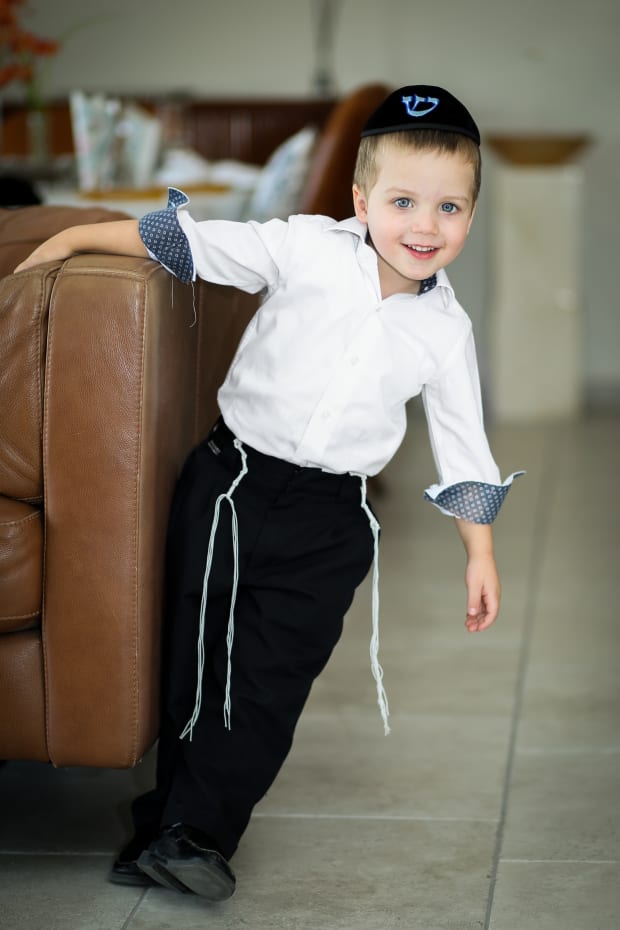
Not that Reform Jewish babies are wearing tzitzit or tefilli. But whenever I see little boys running with their tzitzit flying my heart does swell . . .

Shaulie Dovid's Upsherin - 3 Year Old Hair Cutting Ceremony - Jamie Geller
Photo credit: https://jamiegeller.com/from-jamie/shaulie-dovids-upsherin-3-year-old-hair-cutting-ceremony/

Sukkah 41

The Mishna emphasizes that one needs to use their own lulav on the first day of Sukkot to perform the mitzvah. But what if you don’t have one? Or cannot afford one?

There was an incident involving Rabban Gamliel, and Rabbi Yehoshua, and Rabbi Elazar ben Azarya, and Rabbi Akiva, who were all traveling on a ship during the festival of Sukkot and only Rabban Gamliel had a lulav, which he had bought for one thousand zuz. Rabban Gamliel took it and fulfilled his obligation with it and then gave it to Rabbi Yehoshua as a gift. Rabbi Yehoshua took it and fulfilled his obligation with it and gave it to Rabbi Elazar ben Azarya as a gift. Rabbi Elazar ben Azarya took it and fulfilled his obligation with it and gave it to Rabbi Akiva as a gift. Rabbi Akiva took it and fulfilled his obligation with it and returned it to Rabban Gamliel.

We, as readers, may wonder: what’s the difference between this and borrowing? And, if everyone has now done the mitzvah, why do we need to know that they gave hte lulav back to Rabban Gamliel?

The Gemara teaches that we need to hear this two learn two lessons: 1) a gift given on the condition that it be returned is considered a full-fledged gift; and 2) Anything given to you on condition that you return it to me, and the recipient took it and fulfilled his obligation with it, if he returned the item, he fulfilled his obligation. However, if he did not return the item, he did not fulfill.

So, when we are given a gift on the condition that we give it back – it’s really ours while we hold it. However, if we fail to give it back, any mitzvah we did is retroactively invalid.

It’s hard for me to think of current parallels. Maybe your work laptop? It belongs to your office, you eventually need to return it, but it’s really yours in the meantime . . .

Perhaps a better example is our souls. They belong to God, the are gifted to us, we do mitzvot with them, and, eventually, we must return them. What a beautiful frame to think of it in this way. God gifts us our souls, and, when our mission is completed, we gift it back. . .

Sukkah 40

Today’s daf grapples with how one can purchase an etrog during a Sabbatical year. The Torah tells us that, just as humans and animals get a day of rest every 7th day, the land gets to rest every 7 years. During this time, we don’t work the land but live off of the savings from the past 6 years as well as what the land naturally produces.

So, what do we do about an etrog? As a fruit, it should not be sold during the Sabbatical (shmita) year. But, perhaps since we do not eat it, it has a different status? And what of a lulav? We certainly don’t eat a lulav, can we use one produced in a Sabbatical year?

Sabbatical (shmita) begins on Rosh haShanah. Sukkot is just 2 weeks later. So, one solution is to harvest prior to Rosh haShanah:

The reason that a lulav may be purchased from an am ha’aretz during the Sabbatical Year is specifically that it is a lulav of the sixth year that is entering the seventh. This indicates by inference that a lulav of the seventh year is sacred with the sanctity of the Sabbatical Year.

But then we have the same issue the following year where the fruit and lulav are from the produce of the 7th year . . .

One solution is to say we are not using them for food: The Gemara asks: Why is it sacred? It is merely wood, and wood is not subject to the sanctity of the Sabbatical Year, as it was taught in a baraita: With regard to reed leaves and vine leaves that one piled for storage upon the field, if he gathered them for eating, they are subject to the sanctity of the Sabbatical Year; if he gathered them for use as wood, e.g., for kindling, they are not subject to the sanctity of the Sabbatical Year.

You may be wondering, why do we care so much? What’s the big deal if we sell a fruit that is harvested during the Sabbatical year? Well . . .

Rabbi Yosei bar Ḥanina says: Come and see how severe even the dust of the Sabbatical Year is; (meaning come and see how even a hint of violating the Sabbatical year can lead to severe punishment. While commerce with Sabbatical-Year produce is not one of the primary prohibitions of the Sabbatical Year, its punishment is harsh. A person who engages in commerce with Sabbatical-Year produce is ultimately punished with the loss of his wealth to the point that he is forced to sell his movable property and his vessels, as it is stated: “In this year of Jubilee you shall return every man unto his possession” (Leviticus 25:13), and juxtaposed to it, it is written: “And if you sell an item to your neighbor” (Leviticus 25:14).

Here, the person might not want to give up selling the Sabbatical year produce, because they don’t want to lose the income – well, if they do that, we will be punished with much more financial hardship than keeping the Sabbatical year would have cost them – by losing all their property.

So, why do the rabbis dance around the rules in such a confusing manner? It may seem like the way they parse things makes the laws obsolete, but they clearly still care very deeply about the laws, and believe that if they truly disregard them, they will be divinely punished.

If only all leaders made sure to try and stay within the law, even when it might mean suffering personally a little bit financially.

Sukkah 39

Trash talk, name calling, “dissing” (short for disrespecting), slighting, insulting, cutting, jibe, offence, run down, slam – there are so many names for it, and it goes way back.

A few dapim ago (pSukkah 23a) we had a great example. Rabban Gamliel had ruled that a Sukkah on a ship is unfit, whereas Rabbi Akiva ruled it fit. There was an incident involving Rabban Gamliel and Rabbi Akiva, who were coming on a ship. Rabbi Akiva arose and established a sukka at the top of the ship. The next day the wind blew and uprooted it. Rabban Gamliel said to him: Akiva, where is your sukka?

Ha! Slam. Sorry, Akiva.

Well, today, we get another Talmudic insult – calling someone Moses (in an ironic way):

Rav Safra said to Rava: Moses, did you speak well? Rather . . .

Rav Safra is saying, hey you – the man who is supposed to be hot stuff, as important in this generation as Moses was in his – you’re wrong!

These insults are not the stuff that we should be emulating, but it sure does make the Talmud more amusing. . .

Sukkah 38

Why shul should look a little bit more like a Black Baptist Church.

I grew up at a “Classical Reform” congregation. We would stand when told, sit when told, sing what we were told, read responsive prayers. It was very scripted.

Being as I grew up in the “City of Churches,” it wasn’t long until I became old enough to spend this night at friends’ houses, and accompany them to church. While no church used Hebrew and they all used Jesus, the protestant church felt a lot like my Temple. But then, I got to go to a Black Baptist church.

That was different. That was amazing.

People yelled out! People talked back to the preacher. People said, “Amen,” “Halleluya,” “Praise the Lord!”

I loved it.

Well, our page or Talmud gives a good argument that this style of worship is a lot more ideal than the lukewarm readings/prayers of my youth . . .

Many significant halakhot can be learned from the custom of hallel based on the manner in which it was recited.

Like what?

The prayer leader recites: “Halleluya (Psalms 113:1), and the congregation recites: Halleluya, in response. From here is the source that there is a mitzva to respond: Halleluya.

It’s a mitzvah to respond Halleluya!

Likewise, the prayer leader recites: “Give praise, servants of the Lord” (Psalms 113:1), and the congregation recites: Halleluya, in response. From here is the source of the halakha cited in the mishna that if an adult male was reciting hallel on his behalf, he answers: Halleluya. He recites: “Thank the Lord, for He is good” (Psalms 118:1), and they respond: “Thank the Lord, for He is good.” . . .

Rava continued to cite the significant halakhot learned from hallel. The prayer leader recites: “Lord, please save us” (Psalms 118:25), and the congregation recites: “Lord, please save us,” in response.

Yes! Here it is! Give a Halleluya, a Praise the Lord, a Lord Have Mercy! It’s all a mitzvah. It shows you’re listening, you are engaged, you are moved. And as we shall see, responding will give us credit as it WE said the blessings:

Apropos this halakha, the Gemara relates that the Sages raised a dilemma before Rabbi Ḥiyya bar Abba: If one heard a passage recited and did not recite it himself, what is the halakha? Did he fulfill his obligation or not? He said to them that the Sages, and the schoolteachers, and the heads of the nation, and the homiletic interpreters said: One who heard a passage recited and did not recite it himself fulfilled his obligation.

So, can I get an Amen?

Design a site like this with WordPress.com
Get started